




[Design system](FIGHTRATE_DESIGN_SYSTEM.md) · [Literature notes](docs/data/pesquisa.md) · [Issues](https://git.evandro.dev.br/evandro/HealthTracking/issues)
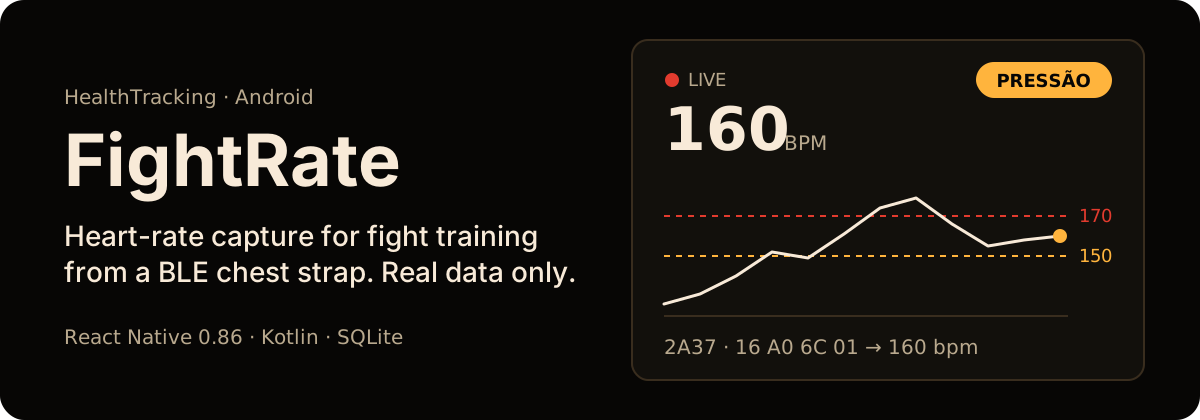
The BLE parser decoding one Heart Rate Measurement packet (flags `0x16`: skin contact detected, one RR interval). It is plain TypeScript, so Node runs it straight from a fresh clone, no install:
```console
$ node --experimental-strip-types --no-warnings --input-type=module -e "import { parseHeartRateMeasurement as parse } from './src/ble/heartRateParser.ts'; console.log(parse([0x16, 0xA0, 0x6C, 0x01]))"
{
bpm: 160,
contactSupported: true,
contactDetected: true,
energyExpended: null,
rrIntervalsMs: [ 355.46875 ]
}
```
## What it is
FightRate (repository `HealthTracking`) is an Android app that records heart rate continuously from a Bluetooth Low Energy chest strap during combat-sport training. It is a bare React Native app (no Expo): a Kotlin foreground service owns the BLE connection and stores every timestamped BPM sample in SQLite, and the React Native UI reads those samples. UI copy is PT-BR; code identifiers are English.
| Tab | What it does |
|---|---|
| **Capture** | Live BPM, average / peak / sample-count tiles, BLE, battery and background status, and the training chart. Start/stop marks a **training window** inside the continuous stream; monitoring keeps storing samples either way |
| **History** | Saved training windows and continuous-usage blocks (split by gaps), each with average / peak / min BPM; open one to inspect the timestamped data; custom time range |
| **Sensor** | BLE scan, device list, connect, connection phase, signal (RSSI), battery level, BLE services/characteristics diagnostics and a shortcut to Android battery-optimization settings |
| **Insights** | Current/average BPM, range, variability, time in zones, load, heart-rate drift, post-session recovery, HRmax/HRR (marked as needing a profile) and HRV (only when the strap sends RR intervals) |
## Why use it
- **Real data only.** Every number on screen is computed from samples a real sensor sent. With no samples the app shows an empty state instead of inventing a peak, zone, load or HRV. Samples outside 30–240 bpm, or reported without skin contact, are discarded.
- **Capture survives the screen turning off.** It runs in a foreground service of type `connectedDevice`, restarts as `START_STICKY`, reconnects with backoff (2 s → 5 s → 10 s → 30 s) and restores the last device after a restart.
- **Built for rounds, not steps.** Fixed zones `BASE <150`, `PRESSÃO 150–169`, `REDLINE 170+`, and a zoomable chart (pinch zoom, pan, tap-to-pin) whose ticks follow the visible span, from half-second to one-minute steps.
Do not use it if you need iOS (there is no native capture module there), zones from your own HRmax or resting heart rate (there is no athlete profile yet), or a signed build you can distribute (see [Project status](#project-status)).
## How it works
1. **BLE client**: `FightRateCaptureService.kt` scans, connects by known device id, subscribes to Heart Rate Measurement `2A37` (service `180D`), reads Battery Level `2A19` and RSSI. After 12 s without a valid sample it reports a stale state and waits for new real data.
2. **Parser**: `HeartRateMeasurementParser.kt` and `src/ble/heartRateParser.ts` read UInt8/UInt16 BPM, skin contact and RR intervals (converted from 1/1024 s to ms).
3. **Storage**: `FightRateCaptureStore.kt` writes `fightrate_rn_capture.db` (schema version 2) with training windows and continuous samples (timestamp, BPM, contact, RR intervals, device).
4. **Bridge**: `FightRateCaptureModule.kt` and `src/native/FightRateCaptureNative.ts` expose start/stop, connect, snapshots and samples, and turn service broadcasts into JS events.
5. **Domain**: pure TypeScript in `src/training/` computes metrics, zones, drift, recovery, usage blocks (a 5-minute gap starts a new block) and the chart viewport.
6. **UI**: a state-driven tab shell in `src/app/FightRateApp.tsx` (no navigation library), Reanimated 4 + Worklets animations and design tokens in `src/theme/`.
Design direction: [`FIGHTRATE_DESIGN_SYSTEM.md`](FIGHTRATE_DESIGN_SYSTEM.md) (**01 — Corner Instrument**, the official one). [`FIGHTRATE_COMBAT_LAB_DESIGN_SYSTEM.md`](FIGHTRATE_COMBAT_LAB_DESIGN_SYSTEM.md) is a deprecated direction kept for history. Specs and plans live in [`docs/superpowers/`](docs/superpowers).
## Quick start
Requirements: Node ≥ 22.11 (`engines` in `package.json`), the Android SDK and a JDK.
```bash
git clone https://git.evandro.dev.br/evandro/HealthTracking.git
cd HealthTracking
npm install
npm run typecheck
npm test -- --runInBand
```
```bash
npm run start # Metro
npm run android # run on a device/emulator
```
Debug APK:
```bash
cd android
./gradlew assembleDebug
# output: android/app/build/outputs/apk/debug/app-debug.apk
```
> [!WARNING]
> **Grant the permissions and exempt the app from battery optimization.** The manifest requests Bluetooth scan/connect, fine location, notifications and a foreground service of type `connectedDevice`. The **Bateria** button on the Sensor tab opens Android's battery-optimization settings (`REQUEST_IGNORE_BATTERY_OPTIMIZATIONS` is declared) so background capture isn't throttled.
If Gradle reports `No Java compiler found`, point `JAVA_HOME` to the JBR bundled with Android Studio:
```bash
export JAVA_HOME="